- Cabinets & Chests
- A FINE BUREAU BOOKCASE ATTRIBUTED TO THOMAS HOPE
A FINE BUREAU BOOKCASE ATTRIBUTED TO THOMAS HOPE
A FINE BUREAU BOOKCASE ATTRIBUTED TO THOMAS HOPE
England, circa 1810
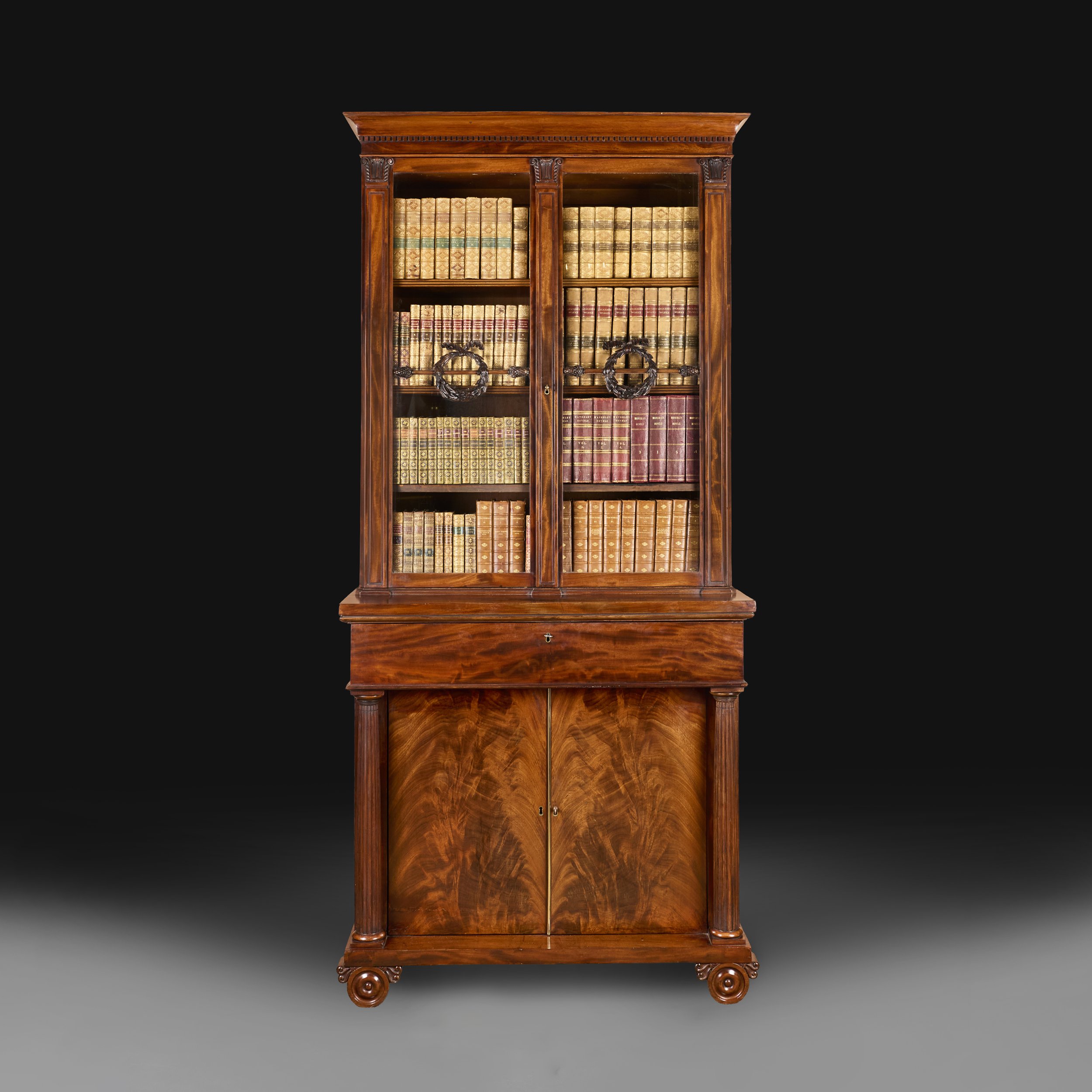
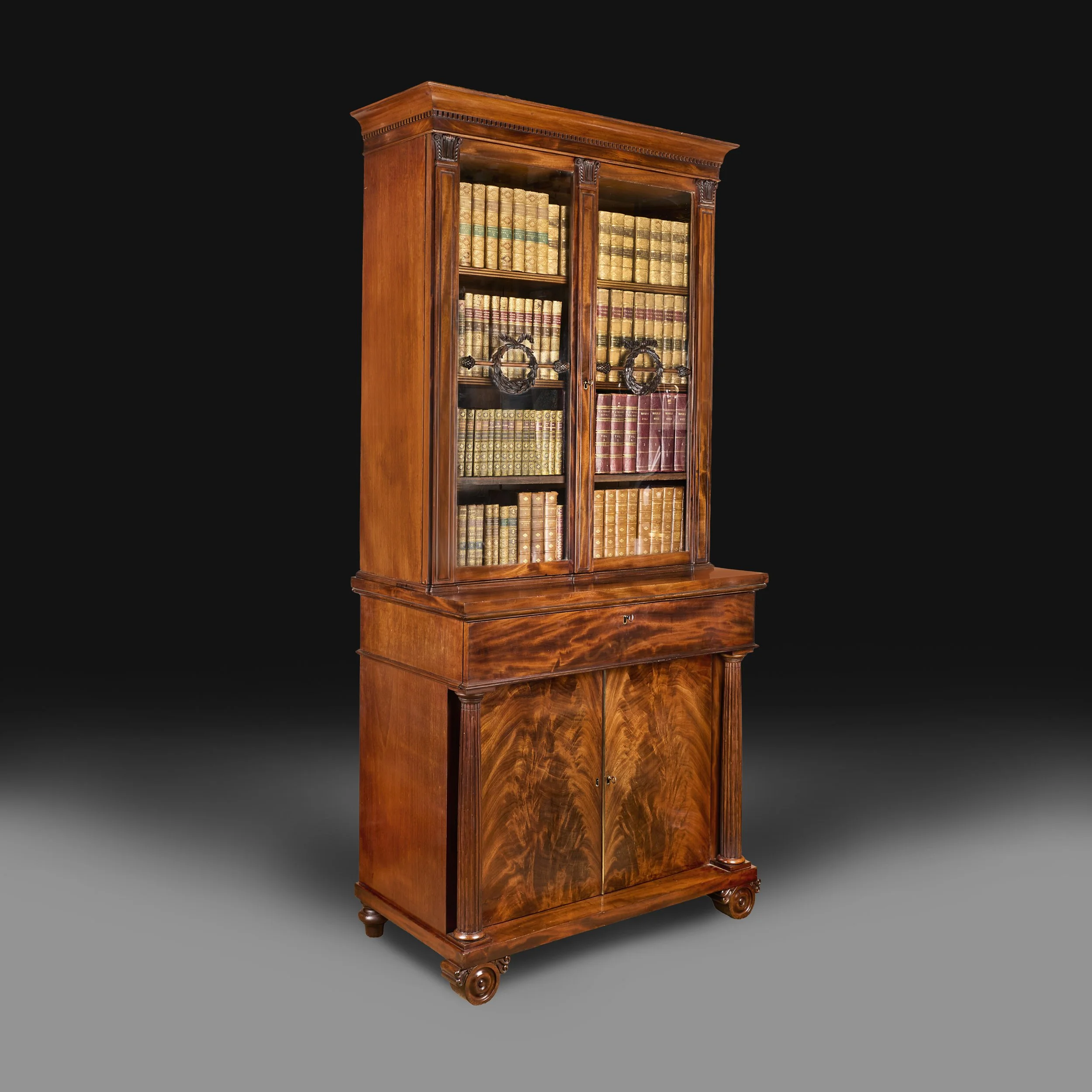
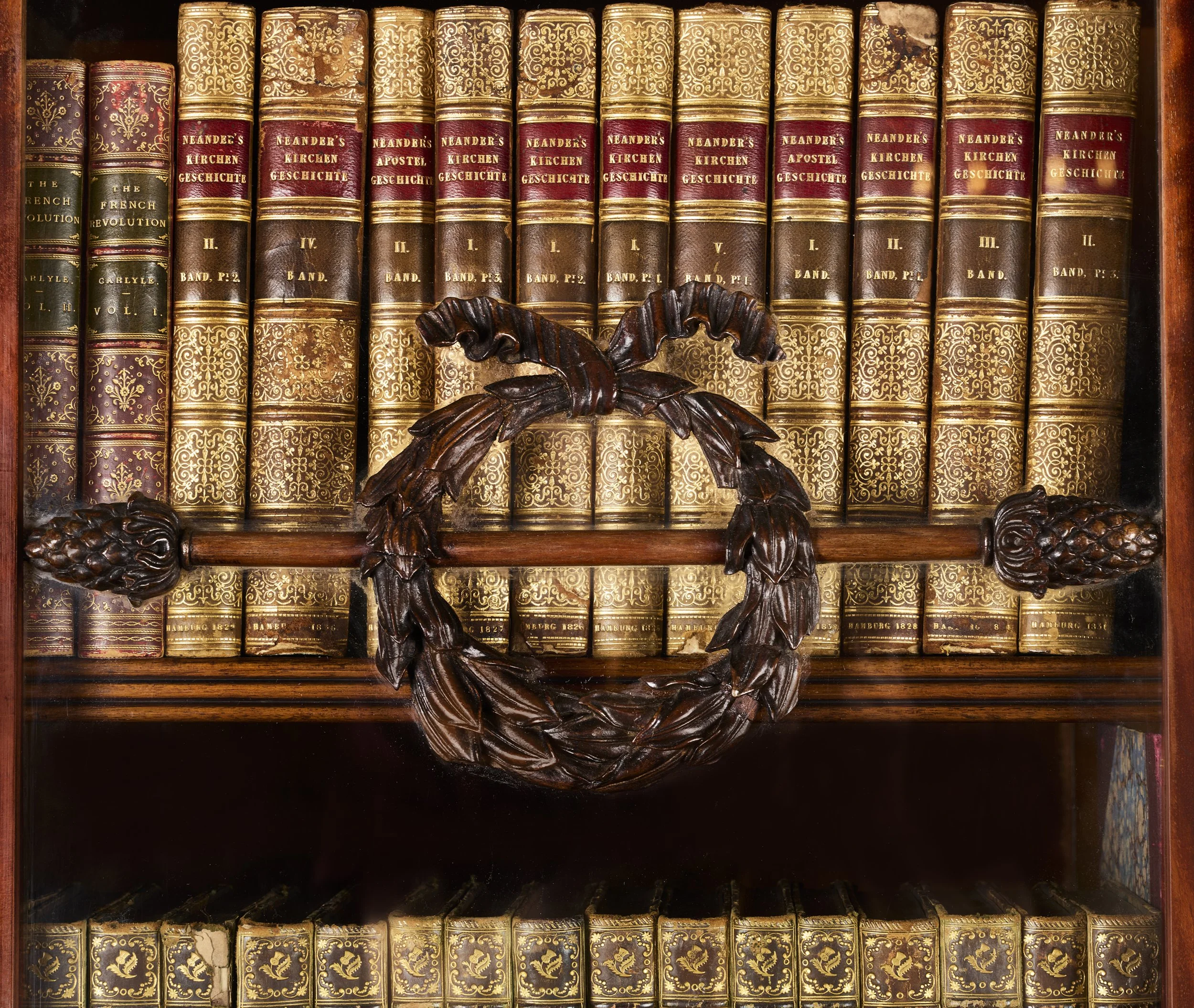
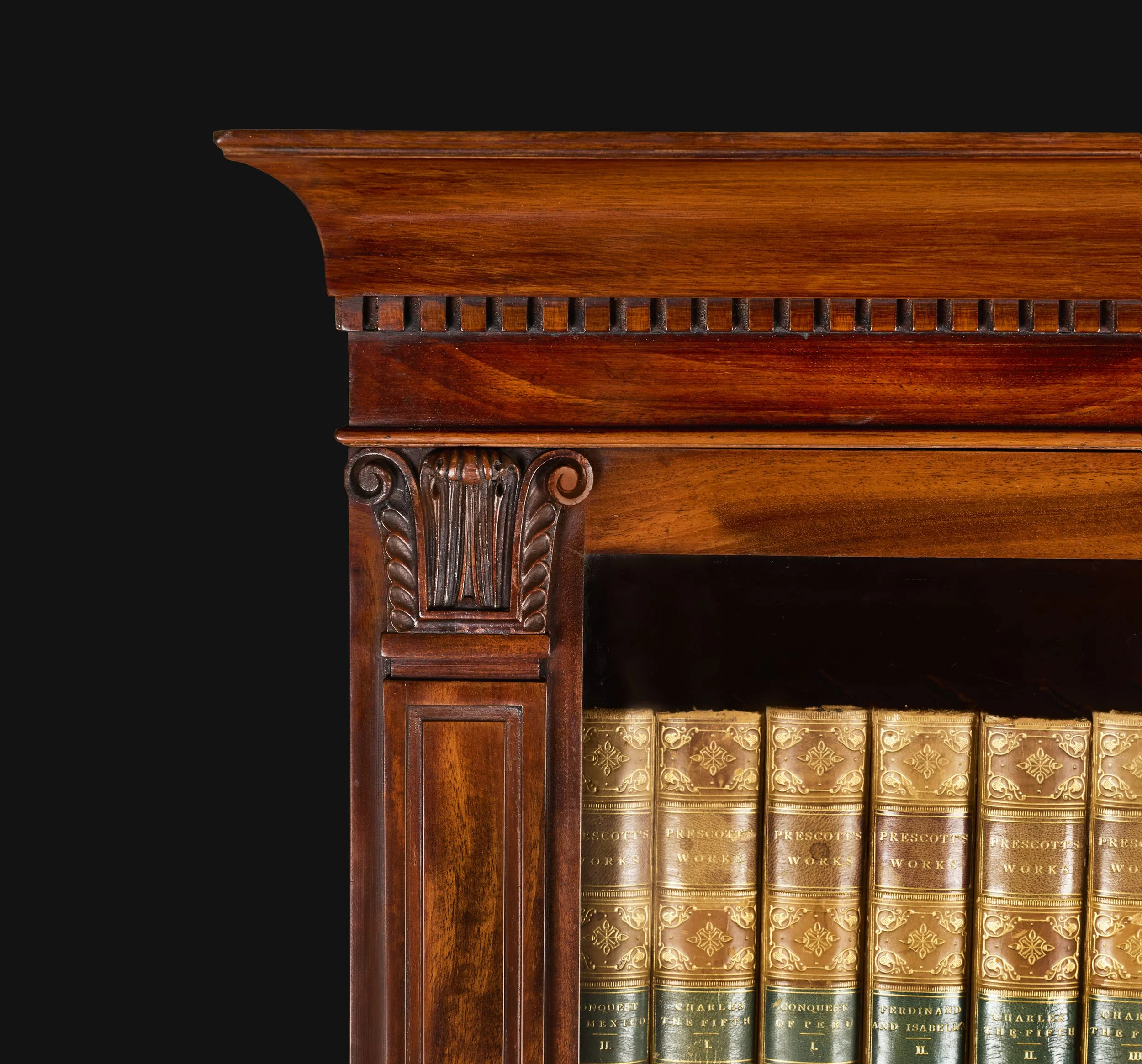
A fine Regency mahogany bureau bookcase, with classical motifs throughout. The upper section comprises a pair of glazed doors set within moulded pilasters crowned with carved acanthus-leaf capitals, below a projecting cornice enriched with a dentil-moulded frieze. The doors decorated with carved laurel wreaths, a favoured Hope motif drawn from classical antiquity, and open to reveal adjustable shelving.
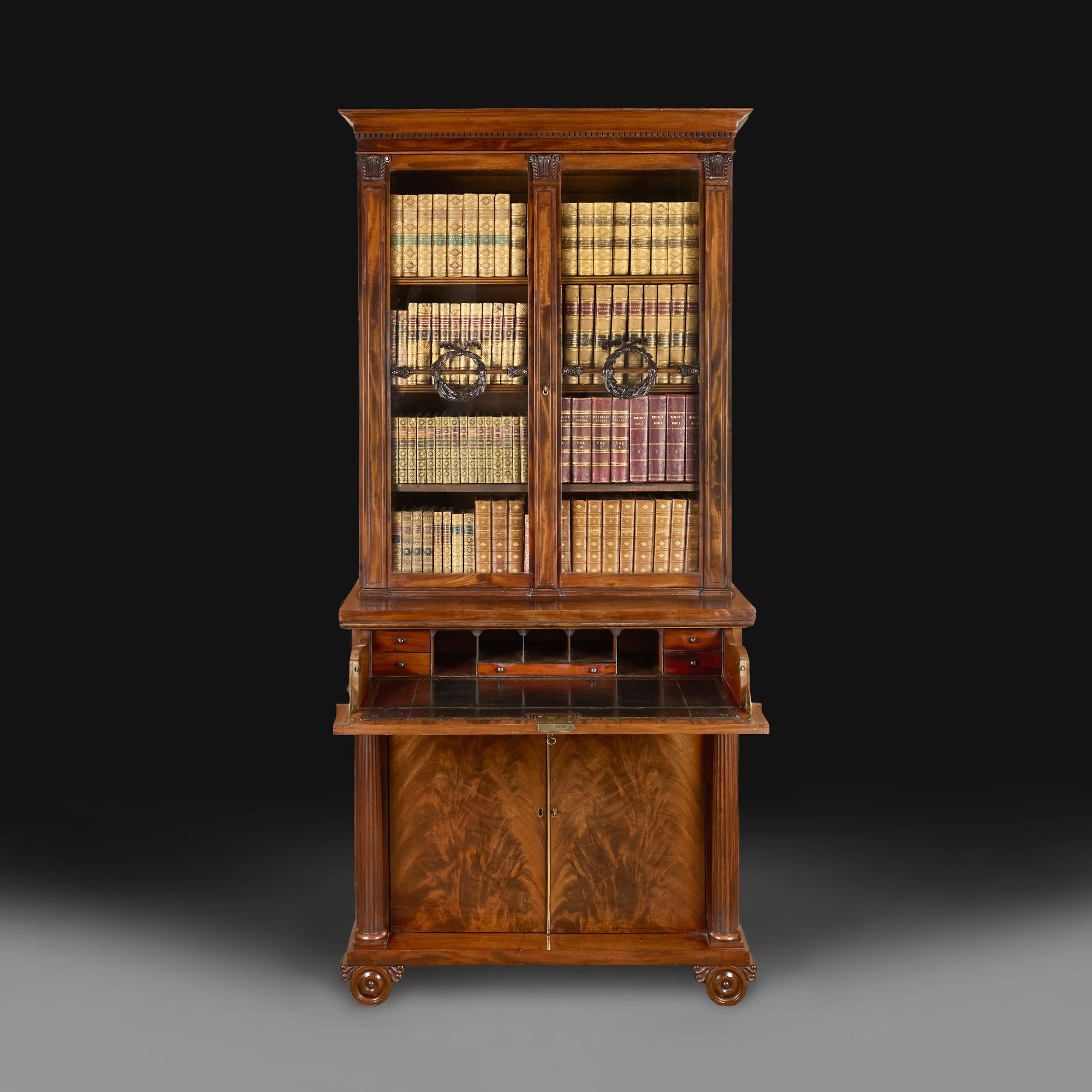
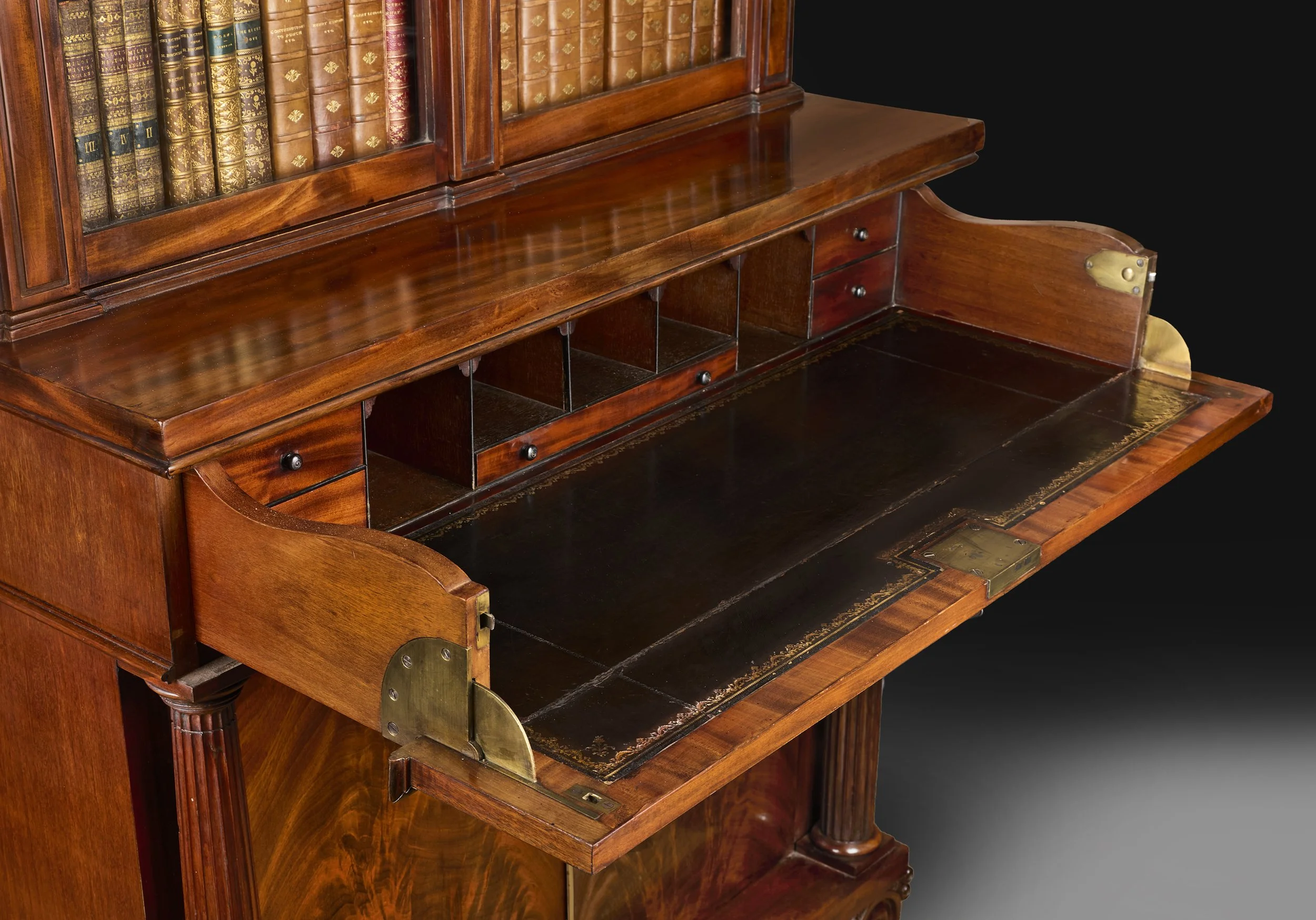
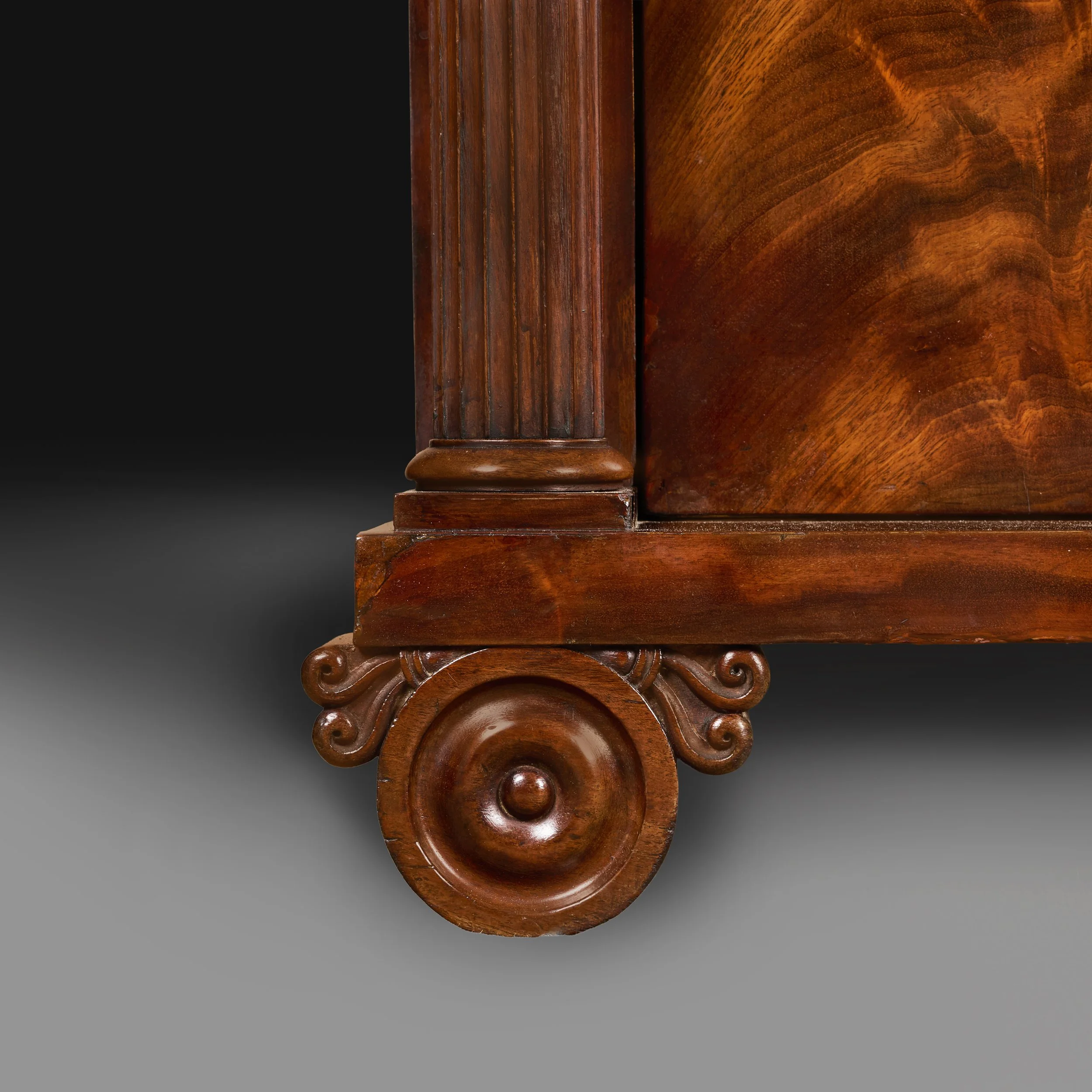
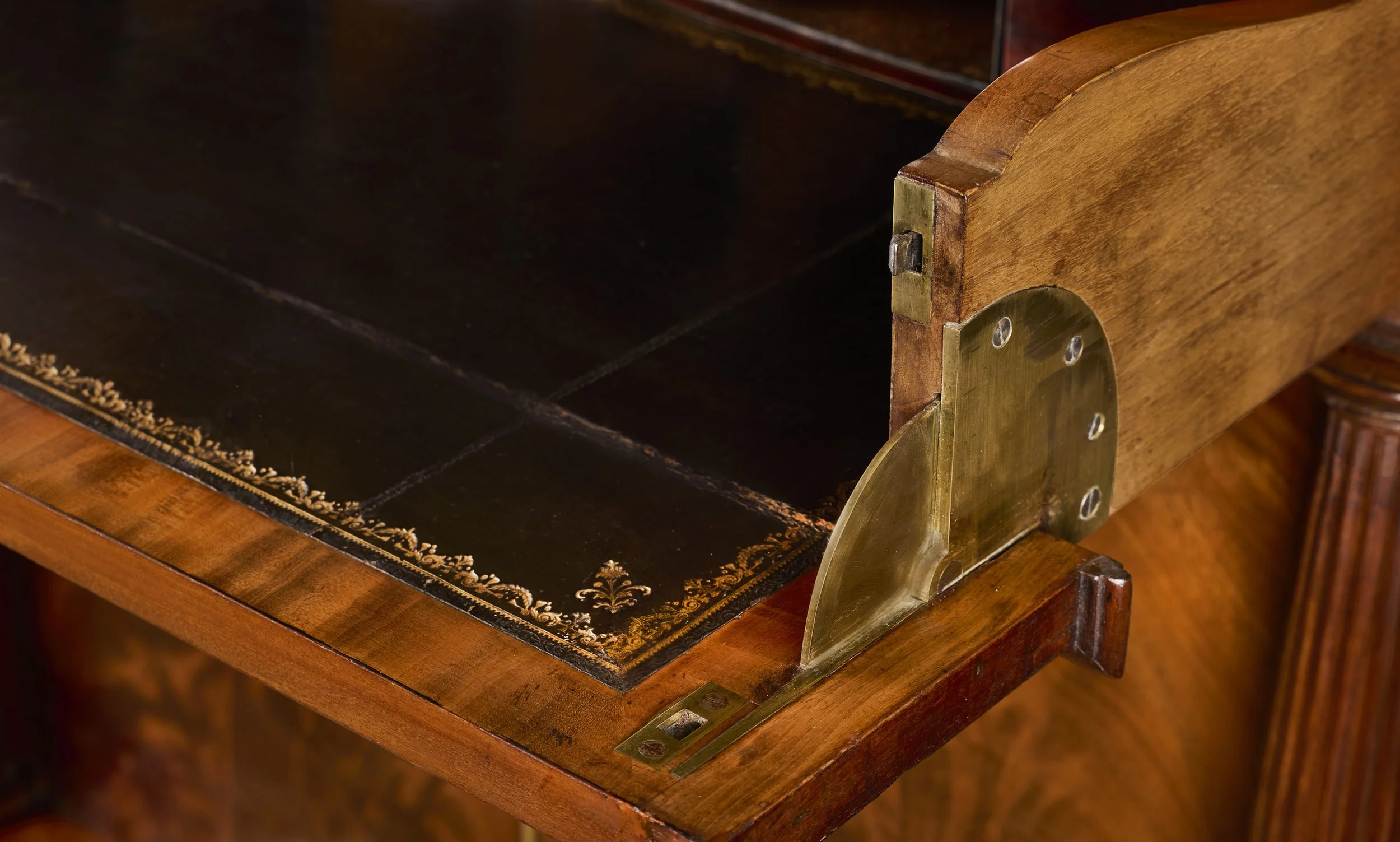
The lower section with a central drawer, opening to reveal a secretaire with gilt tooled leather writing surface, with two flame mahogany doors below, sitting between two fluted columns and all resting on turned bun feet with roundels and acanthus leaf details.
The severity of line, the use of free-standing fluted columns, the classical wreath handles, and the overall Grecian architectural treatment are all hallmarks associated with the designs of Thomas Hope (1769–1831), whose 1807 publication Household Furniture and Interior Decoration did much to popularise this rigorous, antiquity-inspired aesthetic among English cabinetmakers of the period.
Height 218.00cm
Width 101.00cm
Depth 56.00cm
Born into the wealthy merchant banking family Hope & Co. in Amsterdam 1769, Thomas Hope was a hugely influential tastemaker from the English Regency era and used his immense fortune to redefine British interiors by popularizing Neoclassicism. During an extensive Grand Tour throughout Europe and Egypt in his youth, Hope was captivated by the art and antiquities he encountered along the way; an interest which fast developed into a passion that he enjoyed throughout his life.
After fleeing from the French invasion of Holland in 1795, Hope finally settled in London, purchasing a mansion on Duchess Street in 1799. He undertook a complete remodelling of the house, transforming it into a gallery for his enormous collection of Greek vases, classical sculptures and oriental antiquities which he brought back from his travels. The house became a multi-purpose private museum as well as an incredibly influential social hub for London’s elite.
Hope's impact on style was cemented by his publication of 'Household Furniture and Interior Decoration' in 1807, a work containing detailed sketches of his own decorative schemes and introduced the phrase 'interior decoration' into our diction. Hope advocated for a bolder, architectural approach to design, moving forwards from the earlier Georgian period by heavily featuring Neoclassical motifs and shaping the Greek Revival. This 'English Empire' style saw custom furniture characterized by lion's paws, sphinxes and ancient Greek repeating patterns.
Later in his career, Hope broadened his style with his country estate in Deepdene, Surrey. With this project, he created an Italianate palace within picturesque settings. Beyond design, he was a prolific writer, penning books on costume history and the highly acclaimed, exotic 1819 novel Anastasius, which was so engaging it was originally attributed to Lord Byron.
England, circa 1810
A fine Regency mahogany bureau bookcase, with classical motifs throughout. The upper section comprises a pair of glazed doors set within moulded pilasters crowned with carved acanthus-leaf capitals, below a projecting cornice enriched with a dentil-moulded frieze. The doors decorated with carved laurel wreaths, a favoured Hope motif drawn from classical antiquity, and open to reveal adjustable shelving.
The lower section with a central drawer, opening to reveal a secretaire with gilt tooled leather writing surface, with two flame mahogany doors below, sitting between two fluted columns and all resting on turned bun feet with roundels and acanthus leaf details.
The severity of line, the use of free-standing fluted columns, the classical wreath handles, and the overall Grecian architectural treatment are all hallmarks associated with the designs of Thomas Hope (1769–1831), whose 1807 publication Household Furniture and Interior Decoration did much to popularise this rigorous, antiquity-inspired aesthetic among English cabinetmakers of the period.
Height 218.00cm
Width 101.00cm
Depth 56.00cm
Born into the wealthy merchant banking family Hope & Co. in Amsterdam 1769, Thomas Hope was a hugely influential tastemaker from the English Regency era and used his immense fortune to redefine British interiors by popularizing Neoclassicism. During an extensive Grand Tour throughout Europe and Egypt in his youth, Hope was captivated by the art and antiquities he encountered along the way; an interest which fast developed into a passion that he enjoyed throughout his life.
After fleeing from the French invasion of Holland in 1795, Hope finally settled in London, purchasing a mansion on Duchess Street in 1799. He undertook a complete remodelling of the house, transforming it into a gallery for his enormous collection of Greek vases, classical sculptures and oriental antiquities which he brought back from his travels. The house became a multi-purpose private museum as well as an incredibly influential social hub for London’s elite.
Hope's impact on style was cemented by his publication of 'Household Furniture and Interior Decoration' in 1807, a work containing detailed sketches of his own decorative schemes and introduced the phrase 'interior decoration' into our diction. Hope advocated for a bolder, architectural approach to design, moving forwards from the earlier Georgian period by heavily featuring Neoclassical motifs and shaping the Greek Revival. This 'English Empire' style saw custom furniture characterized by lion's paws, sphinxes and ancient Greek repeating patterns.
Later in his career, Hope broadened his style with his country estate in Deepdene, Surrey. With this project, he created an Italianate palace within picturesque settings. Beyond design, he was a prolific writer, penning books on costume history and the highly acclaimed, exotic 1819 novel Anastasius, which was so engaging it was originally attributed to Lord Byron.